Arnold@realfilterpress.com
18103836612
Choosing the right sludge dewatering equipment is an important decision for wastewater treatment plants, palm oil mills, industrial wastewater facilities, and other sludge treatment projects.
Two commonly considered technologies are the belt filter press and the filter press, including chamber filter presses and plate-and-frame filter presses.
So, which one is better?
The answer is not simply that one technology is better than the other.
The right choice depends on several factors, including:
Sludge characteristics
Sludge flow and solids loading
Required cake dryness
Continuous or batch operation
Polymer consumption
Sludge transportation and disposal costs
Available operating space
Maintenance requirements
Total operating cost
This article explains the key differences between belt filter presses and filter presses and discusses when each technology may be appropriate.
A belt filter press is a continuous sludge dewatering machine.
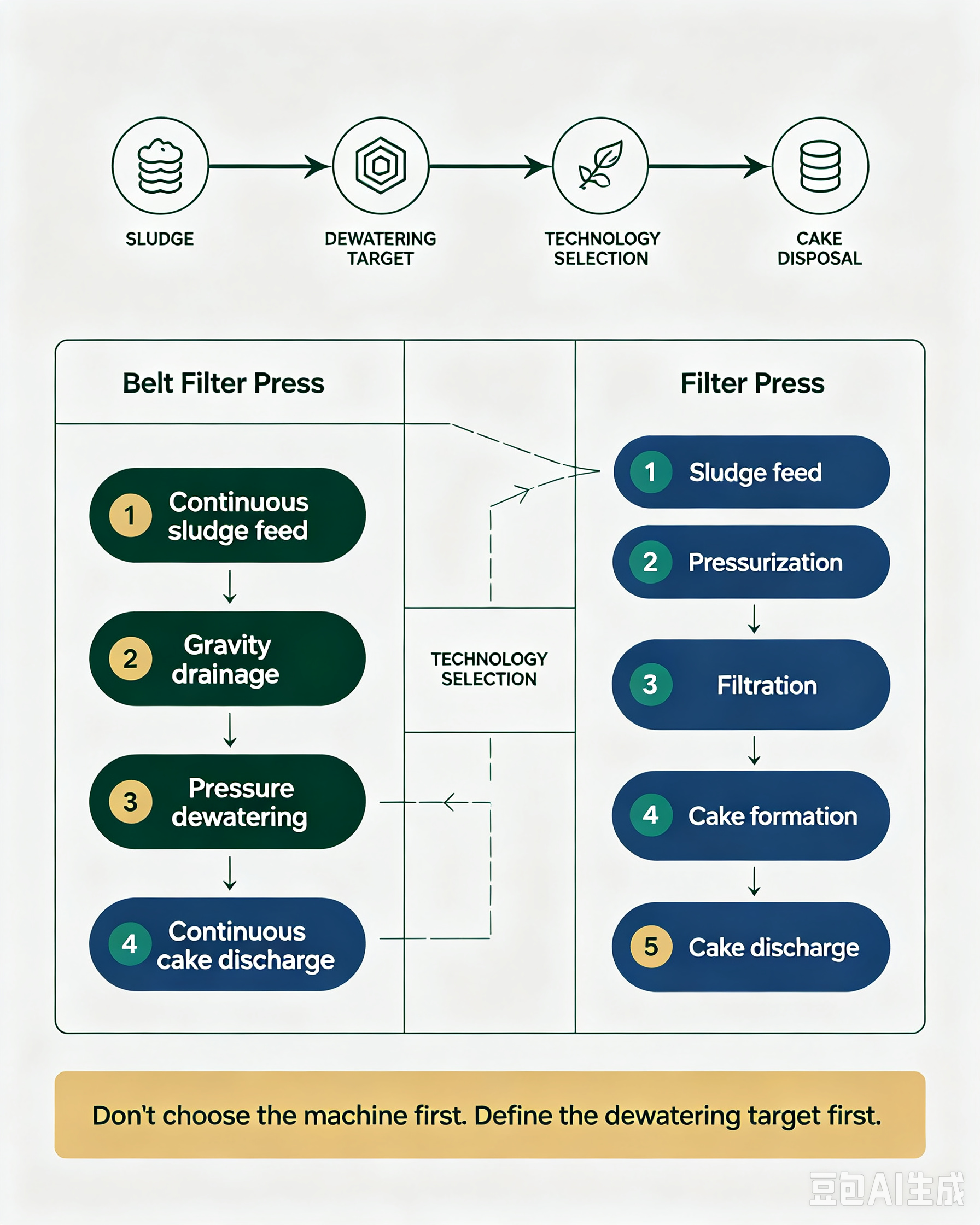
Conditioned sludge is normally mixed with polymer before entering the dewatering section. The sludge first passes through a gravity drainage zone, where free water is removed. It then moves through a series of rollers that progressively apply mechanical pressure to the sludge.
The dewatered sludge cake is continuously discharged from the machine.
A typical belt filter press process can be simplified as:
Sludge feeding → Polymer conditioning → Gravity drainage → Pressure dewatering → Continuous cake discharge
Because the process is continuous, belt filter presses can be attractive for wastewater treatment plants and industrial facilities with relatively stable and continuous sludge production.
A filter press is a pressure filtration system that operates in batches.
Depending on the design, common configurations include chamber filter presses and plate-and-frame filter presses.
Sludge is pumped into the filter press under pressure. Solid particles are retained by the filter cloth while water passes through the filtration channels.
As filtration continues, a sludge cake forms inside the filter chambers.
The basic process is:
Sludge feeding → Pressure filtration → Cake formation → Filtration completion → Cake discharge → Next cycle
Compared with a belt filter press, a filter press can apply significantly higher filtration pressure.
This makes it particularly useful when achieving a relatively dry filter cake is an important project requirement.
The following factors are important when comparing the two technologies.
One of the most obvious differences is the operating mode.
A belt filter press is designed for continuous operation.
Sludge can be continuously fed into the machine while dewatered cake is continuously discharged.
This can be advantageous when:
Sludge production is continuous
The sludge flow is relatively stable
Large volumes need to be processed
Continuous sludge handling is preferred
A filter press operates in cycles.
A typical cycle includes:
Feed → Filtration → Pressure holding → Cake formation → Cake discharge → Cloth cleaning → Next cycle
Therefore, the required capacity must be calculated based on the filtration cycle time and the amount of sludge generated.
Multiple filter presses can also be installed in parallel when higher processing capacity is required.
Cake dryness is one of the most important factors in sludge dewatering.
A belt filter press uses gravity drainage and mechanical compression to remove water from sludge.
A filter press uses pressure filtration to separate liquid from solids.
Because a filter press can operate at significantly higher filtration pressure, it can often achieve a higher solids concentration in the final cake, depending on the sludge characteristics and operating conditions.
However, cake moisture is not determined by equipment type alone.
Important factors include:
Sludge type
Feed solids concentration
Sludge compressibility
Filter cloth selection
Polymer conditioning
Feed pressure
Filtration time
Cake thickness
Therefore, actual cake dryness should be confirmed through testing or previous operating data whenever possible.
Polymer, commonly referred to as PAM in many wastewater treatment applications, is often used to condition sludge before mechanical dewatering.
The required polymer dosage can vary significantly depending on the sludge.
For example, municipal wastewater sludge, palm oil mill sludge, chemical sludge, and mineral-processing sludge may have very different dewatering characteristics.
Therefore, it is not accurate to assume that one type of dewatering equipment will always consume less polymer.
A proper comparison should consider:
Polymer dosage × sludge flow × polymer price × annual operating hours
Jar testing and on-site operating trials can help determine an appropriate polymer dosage.
This is an important consideration that is sometimes overlooked during equipment selection.
The final dewatered sludge cake contains both solids and residual water.
If the disposal company charges according to sludge weight or volume, additional water in the cake can increase transportation and disposal costs.
For this reason, the target cake solids concentration should be considered together with the downstream disposal method.
For example:
Higher cake solids → Less water transported → Potentially lower transportation and disposal cost
The actual economic benefit depends on local disposal fees, transportation distance, cake characteristics, and the final disposal route.
Both technologies require routine maintenance, but the consumable components are different.
For a belt filter press, important maintenance items may include:
Filter belts
Belt washing system
Rollers
Bearings
Scrapers
Polymer dosing system
For a filter press, typical maintenance items may include:
Filter cloths
Plate sealing surfaces
Hydraulic system
Feed pump
Plate-shifting mechanism
Cloth washing system
Filter cloth life depends on sludge characteristics, chemical compatibility, washing frequency, operating pressure, and cloth material.
Similarly, belt life depends on operating conditions, sludge properties, washing practices, alignment, and mechanical maintenance.
Therefore, consumable replacement should be included in the total operating cost calculation rather than comparing equipment based only on purchase price.
Available space can also influence equipment selection.
A belt filter press normally requires space for continuous sludge feeding, belt washing, cake discharge, and maintenance access.
A filter press requires sufficient space for plate opening, cake discharge, cloth maintenance, and equipment access.
The actual footprint depends on:
Equipment capacity
Number of units
Cake discharge arrangement
Sludge storage tanks
Polymer preparation system
Feed pumps
Maintenance access
For a complete project, the dewatering system should therefore be evaluated as a whole rather than looking only at the main machine dimensions.
There is no universal answer.
A belt filter press may be considered when the project prioritizes:
Continuous sludge processing
Stable and continuous sludge production
Large sludge volumes
Automated continuous cake discharge
Moderate cake dryness requirements
A filter press may be considered when the project prioritizes:
Higher pressure filtration
Higher cake solids concentration
Reduced water content in the final cake
Lower downstream sludge transportation requirements
Batch or intermittent sludge production
However, the final selection should always be based on the actual sludge and project conditions.
Instead of asking:
“Which machine is better?”
A better engineering approach is to ask the following questions.
Different sludge types have very different dewatering characteristics.
For example:
Municipal wastewater sludge
Palm oil mill sludge
Chemical wastewater sludge
Food-processing sludge
Mining tailings
Mineral-processing sludge
should not automatically be treated using the same operating parameters.
The required equipment capacity should be based on the actual sludge loading.
Important data includes:
Wet sludge flow rate
Dry solids concentration
Dry solids production per day
Operating hours per day
Required dewatering hours
This is one of the most important questions.
If the downstream disposal process requires a relatively dry cake, pressure filtration may deserve closer consideration.
If moderate cake dryness is acceptable and continuous operation is a priority, a belt filter press may be suitable.
The final disposal method can significantly affect equipment selection.
Possible destinations include:
Landfill
Incineration
Composting
Agricultural application
Further treatment
Industrial reuse
The required cake characteristics should be determined according to the downstream process.
Equipment selection should not be based only on the initial purchase price.
A more complete calculation should include:
CAPEX + electricity + polymer + water + labor + consumables + maintenance + sludge transportation + disposal
This provides a better basis for comparing different dewatering technologies.
| Factor | Belt Filter Press | Filter Press |
|---|---|---|
| Operating mode | Continuous | Batch |
| Sludge feeding | Continuous | Cyclic |
| Cake discharge | Continuous | Batch |
| Filtration pressure | Mechanical pressure | High-pressure filtration |
| Cake dryness | Moderate to high, depending on sludge | Often higher, depending on sludge |
| Large continuous flow | Suitable for many applications | Can require multiple units |
| Polymer requirement | Application dependent | Application dependent |
| Main consumables | Filter belts and related components | Filter cloths and related components |
| Maintenance | Belt, rollers, washing system | Cloth, plates, hydraulic system |
| Best suited to | Continuous, stable sludge flow | Applications prioritizing pressure filtration and cake dryness |
The table should be used as a starting point rather than a substitute for project-specific engineering evaluation.
The selection between a belt filter press and a filter press should not be based on the machine alone.
The better approach is to start with the sludge characteristics, required capacity, target cake solids, operating conditions, and downstream disposal requirements.
In some projects, continuous operation and high throughput may be the main priorities.
In other projects, achieving a higher cake solids concentration and reducing downstream sludge handling costs may be more important.
The right sludge dewatering system is therefore the one that provides the best overall match between:
Sludge Characteristics + Capacity + Cake Target + Operating Cost + Disposal Requirements
For wastewater treatment plants, palm oil mills, and industrial sludge treatment projects, these factors should be evaluated before selecting the final dewatering technology.
If you are evaluating a belt filter press or chamber filter press for a specific sludge dewatering project, providing the sludge flow rate, solids concentration, required operating hours, and disposal method is a good starting point for equipment sizing and process evaluation.
Contact: Arnold
Phone: 18103836612
E-mail: Arnold@realfilterpress.com
Whatsapp:+8618103836612
Add: Room1087, Unit 2,Building 1,No.89 Hongye Road,Zhengzhou National High and New Technology Industries Development Zone, Zhengzhou, Henan ,China
We chat